
This question refuses to die.
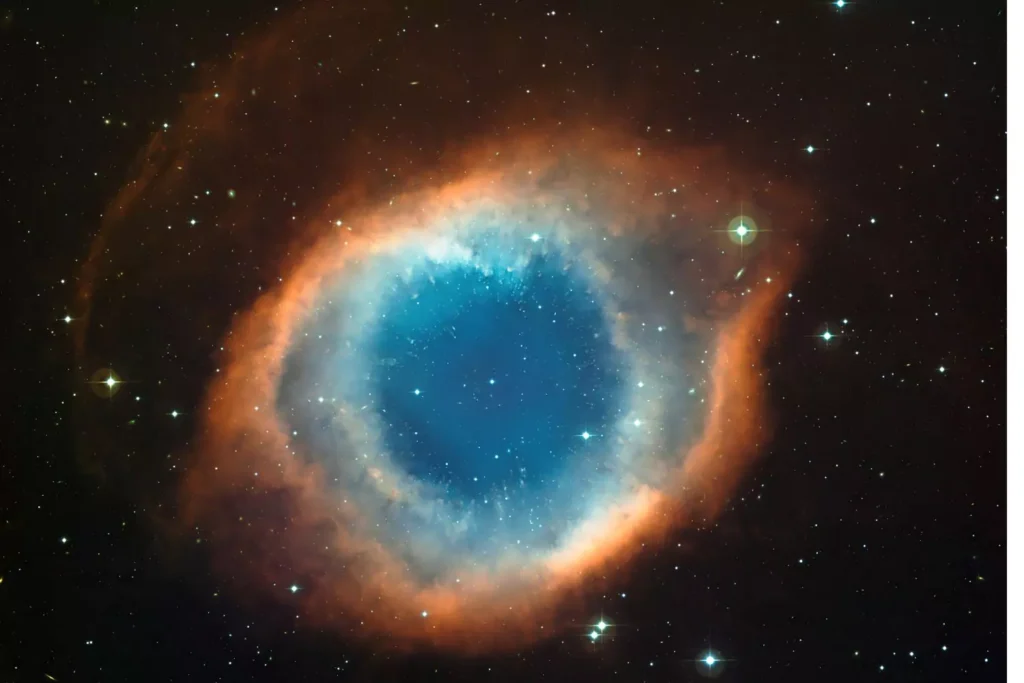
It has survived many empires, scriptures, revolutions, science, and even space exploration. From forest-dwelling sages to modern laboratories, humanity has kept returning to the same unsettling thought again and again that : Is God real or The God is our greatest invention of all time ?
Look at the night sky.There are Billions of galaxies. Trillions of stars. Mathematical precision. Predictable orbits. Physical laws that never seem to fail. From the smallest atom to the largest galaxy, everything appears to follow a hidden order.This naturally leads to one of humanity’s deepest questions:If there is no God, then why is the universe so perfectly structured?And if there is a God, why does the universe run on laws instead of miracles?
If God sees everything, then inequality and violence are not failures of God’s vision, but reflections of human choice.Perhaps God does not intervene because morality was never meant to be enforced from above, but practiced from within.
This is not just a religious question.It is a scientific, philosophical, and metaphysical puzzle one that has challenged Buddha, Einstein, Newton, Dawkins, and countless civilizations across history.
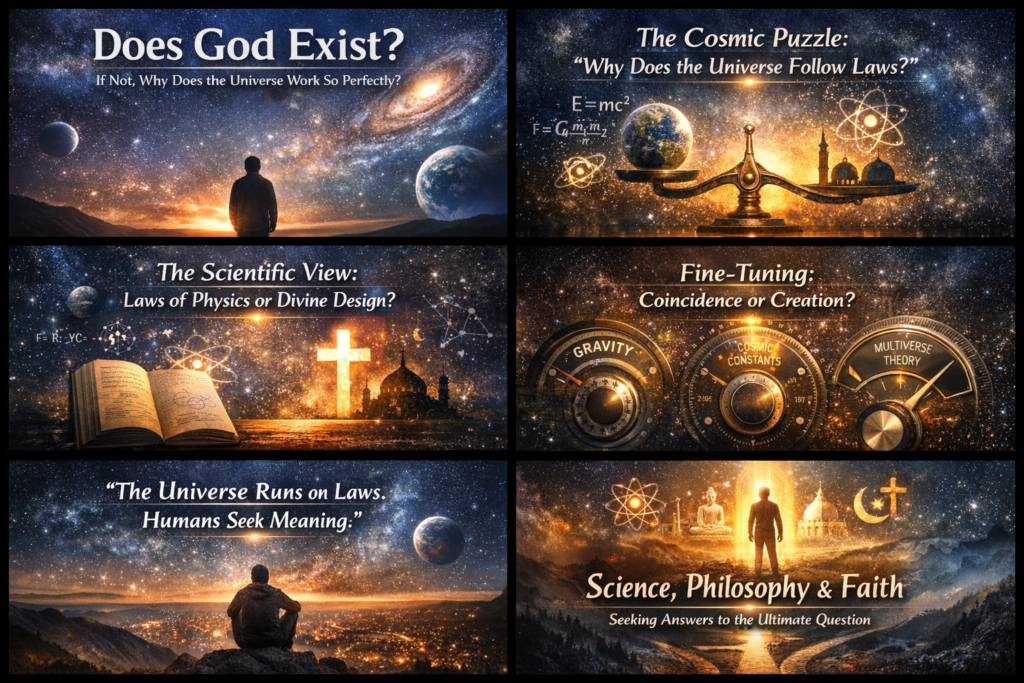
The Scientific Reality: A Law-Governed by the Universe
Modern science describes the universe as a system governed by universal laws:
Newtonian mechanics governs motion at everyday scales.
Einstein’s general relativity explains gravity as the curvature of spacetime.
Quantum mechanics governs subatomic Interactions.
The Standard Model explains fundamental particles and forces.
These laws operate independently of human belief or observation. The universe does not require intention or consciousness to function—it follows mathematical relationships that can be empirically tested and repeatedly verified.
“The most incomprehensible thing about the universe is that it is comprehensible.” – Albert Einstein
“Science however addresses how the universe behaves but not why it exists.”
The Origin Problem: Where Do the Laws Come From?
Cosmology traces the universe back to the Big Bang, approximately 13.8 billion years ago. At that moment, space, time, matter, and energy emerged from an extremely hot, dense state.Yet science reaches a conceptual boundary here:
Why did the Big Bang occur?
Why do physical laws exist at all?
Why do constants have the specific values they do?
Physics can describe what happened after the beginning, but it cannot currently explain why there is something rather than nothing.This gap is not a failure of science—it is the limit of its methodology.
The Religious Explanation: A Lawgiver Behind the Laws
Religions see order as evidence of intelligent design.
Christianity say’s
“In the beginning was the Word (Logos).” — Bible here, Logos means reason, order, structure.
Islam say’s
“He raised the heaven and imposed balance.” — Quran 55:7
Judaism say’s
” God creates the universe through command, not chaos.”
Hindu Philosophy
cosmic order that governs gods, humans, and nature.
Across religions, God is not portrayed as someone constantly interfering, but as:
👉 The origin of Order.
👉The source of laws.
👉The ground of existence.
The Metaphysical View: Something Beyond God and Science.
Eastern philosophies and modern metaphysics offer a third position.
Non-Theistic Philosophical Explanations.
Eastern philosophies often avoid the concept of a personal creator altogether.
Buddhism –
The universe arises through dependent origination that is cause and effect without a creator. “Speculation about the origin of the universe does not lead to liberation.” — Buddha
Advaita Vedanta
Reality is Brahman—existence itself, not a designing agent.In these systems, order is not imposed but inherent.

Modern Scientific view
Richard Dawkins says The universe we observe has precisely the properties we should expect if there is no design.
”From this view : Natural selection explains complexity in biology.
Physical laws require no intention.
Human meaning is self-created.
Friedrich Nietzsche
“God is dead.” Nietzsche did not argue that God never existed, but that traditional metaphysical explanations had lost authority. Humans must now construct values without divine grounding.
Einstein’s Position:
Order Without a Personal God .Einstein rejected a personal, God but acknowledged the mystery of order.
“I believe in Spinoza’s God, who reveals himself in the orderly harmony of what exists.”This perspective accepts: No divine intervention. No supernatural Will but profound rational structure underlying reality.
The Human Dimension
Despite scientific progress, belief in God persists.This persistence is not due to ignorance, but because science does not address:Moral meaning .Existential anxiety.Suffering and loss.When explanation ends, interpretation begins.God functions psychologically and culturally—even if not scientifically required.
Conclusion: Science Explains the Mechanism, Not the Meaning .
The universe operates according to discoverable laws.No scientific evidence currently requires God to run the universe.However:Science does not explain why laws Exist. science does not address meaning or Purpose .science does not resolve existential questions. God, therefore, is not a scientific necessity—but remains a philosophical and psychological response to unanswered questions.
Final Conclusion
The universe may not require God to function.But the human mind seeks meaning beyond function.Whether that meaning is described as God, cosmic order, natural law, or pure existence is ultimately a matter of interpretation—not measurement.
The universe runs on laws.Humans run on meaning.And the tension between the two is where this question will always remain.