
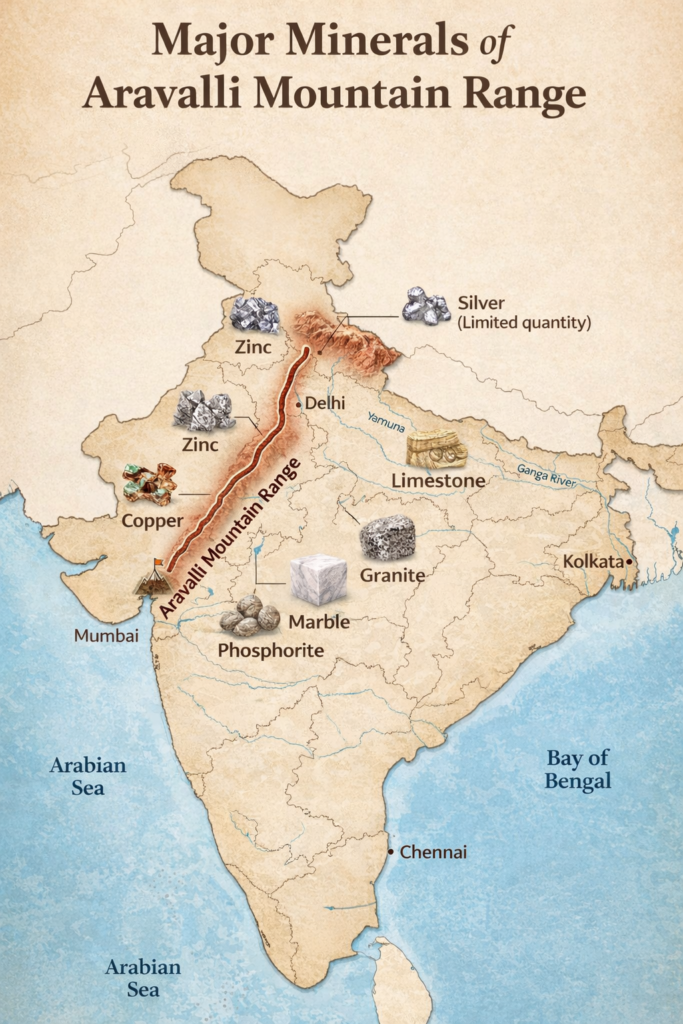
The Aravalli Range is the oldest mountain range in India and among the oldest in the world, formed approximately 1.5 to 2 billion years ago. Stretching over 800 km, it runs from Palanpur in Gujarat through Rajasthan and Haryana, reaching up to Delhi.
The Aravallis are ancient, eroded mountains that protect India’s climate, water security, biodiversity, and ecological balance—making them environmentally irreplaceable.
Why the Debate on the Aravallis ?
The very existence of the Aravalli mountain range spread across four states has come under judicial scrutiny. Through a court order, serious questions have been raised about the large-scale mining being carried out in the Aravallis. It is alleged that the central government has allowed mining in the Aravalli range on a large scale for the benefit of major industrialists, and that builders in Delhi have benefited from this. This has caused severe environmental damage to the Aravalli ranges in Delhi, Rajasthan, Gujarat, and Haryana, triggering strong reactions.
The Aravalli Range Is at the Center of the Controversy
The central government is accused of making attempts to destroy the mountains. While the government claims it has taken protective measures, the importance of the Aravalli range remains at the heart of this political controversy.
What Is the Issue Related to the Aravalli Range?
Mining activities have been ongoing for decades in the Aravalli range, especially extensive extraction of sand and stone. Due to this, the existence of certain hills has come under threat. Several petitions regarding the Aravalli range have been pending before the courts.
The Supreme Court issued an important order on May 9, 2024, directing that mining activities in the Aravalli ranges of Delhi, Haryana, Rajasthan, and Gujarat be brought to an end. According to this order, no new mines will be granted permissions, though legally operating mines may continue. However, confusion arose due to different interpretations of the order, and the central government’s environment ministry set up a committee to define the scope of the Aravalli range and frame policy.
What Exactly Was the Supreme Court’s Order?
The Supreme Court accepted the definition of the Aravalli range submitted by the Union Ministry of Environment on November 20, 2024. After this, controversy arose over whether mining could resume in areas lying outside the defined boundaries.
According to the definition, areas with hills lower than 100 meters will not be considered part of the Aravalli range. Only 10% of the Aravalli region lies above 100 meters, while 90% is below this height. This opened a pathway for mining in nearly 90% of the Aravalli region, leading to allegations—particularly in Rajasthan—that this definition was crafted to facilitate mining. This sparked the “Save Aravalli” movement. The Supreme Court has taken cognizance of these objections.
What Are the Consequences of Mining in the Aravallis?
Mining in the Aravalli range has caused severe environmental damage, particularly in Haryana. In Mahendragarh district, groundwater levels have dropped drastically. In this district, water tables that once existed at depths of 1,400–2,000 feet have significantly declined. In 90% of mining-affected areas, groundwater has completely disappeared.
Illegal mining continues in many places. As a result, dust pollution has increased, waste dumping has expanded, water sources have dried up, and vegetation is being destroyed. Environmentalists have raised serious concerns, stating that the Aravalli range is being systematically devastated.
Why Is the Aravalli Range Important?
The Aravalli range plays a crucial role in preventing the desertification of the plains in the Ganga and Indus river basins. It acts as a natural barrier that stops the Thar Desert from spreading eastward.
The Aravallis also help stabilize the climate, support biodiversity, recharge groundwater, and regulate rainfall. They are vital for ecological balance.
Several important rivers originate in the Aravalli range, including Banas, Sabarmati, and Luni. The range is also rich in minerals such as copper, zinc, lead, gold, silver, marble, granite, shale, limestone, and tungsten.